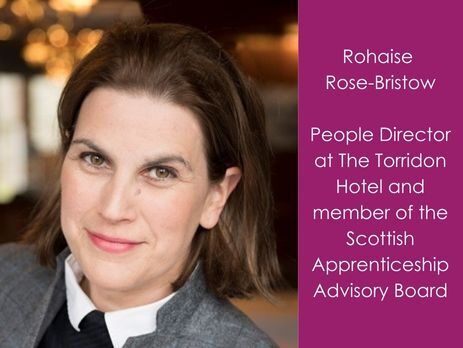
Industry Feature: The importance of apprenticeships to the hospitality and tourism sector – Rohaise Rose-Bristow, People Director at The Torridon Hotel
Rohaise Rose-Bristow, People Director at The Torridon Hotel and member of the Scottish Apprenticeship Advisory Board, an independent body of industry leaders working to ensure Scottish Apprenticeships meet the needs of industry, highlights the importance of apprenticeships to the hospitality and tourism sector, the specific challenges faced by rural establishments and how apprenticeships offer a solution to skills shortages.
I’ve always felt that hospitality is a uniquely special environment for any person to learn within, and one of the best starts to a career.
The skills needed for a role in hospitality all centre around human interaction: communication, social intelligence, collaboration. Unlike some industries that are transforming the way they work through automation and AI, hospitality is an industry where people, in numbers, will always be needed.
We need to attract more people into hospitality roles, while embedding a sustainable, reliable pipeline of talent for such a crucial sector to Scotland.
Hospitality and tourism is worth over £5.1 billion to the Scottish economy. It employs over 182,000 people and is only set to grow, as we continue to fight back to pre-pandemic levels. By 2025, figures show that the sector will need to recruit over 42,000 people to keep up with demand. So, the jobs are there – but the big question is, ‘how do we get enough people, with the right skills, to meet the demand?’
This is where ‘earning while learning’ through apprenticeships can start to offer a solution.
With our sector being so practical in its nature, I really do believe that nothing can beat on-the-job learning. Apprenticeships offer structured training with recognised qualifications. An apprenticeship in hospitality helps promote consistency and professionalism across the sector and improve its attractiveness to young people (and their parents and carers as their biggest influencers) when making those important career decisions.
The longer-term commitment to learning through an apprenticeship can help provide a degree of certainty which helps with some of the specific challenges faced in hospitality generally and especially by rural businesses.
At the Torridon, we currently have 45 out of 55 staff – including our apprentices – living onsite at our hotel in Wester Ross in the Highlands. It can make practical sense for some rural businesses in hospitality to operate this way – firstly, colleges simply can’t replicate the real-world environment that people need, working within the service industry. Secondly, the human experience part of the job does not adapt easily to online or remote learning – learning skills onsite, through experience, helps people develop the right skills, faster. Thirdly, and significantly, it makes sense for us, delivering training on location – when you consider that the nearest college is over 65 miles away.
There’s been a lot of work gone into investing and developing apprenticeships through employers, as we saw through the Apprenticeship in Hospitality Scotland (AHS) programme. AHS is a ground-breaking training course which started as a partnership between hotels across Scotland – Cameron House, Auchrannie, Turnberry, The Dalmahoy and Apex to name a few. Apprentices get to do a Modern Apprenticeship in Hospitality Services and spend time in key departments; housekeeping, food and beverage, kitchen and reception, across different hotels over the lifespan. The variety of exposure to different venues and specialisms, along with a recognised qualification can prove to be a real pull for talent.
This is evidence of how – as a sector – we have forged our strength together, to collectively overcome issues of access to skills and labour. But we need help to support this. We need national apprenticeship programmes to work for local economies.
Rural economies rely so heavily on hospitality and tourism with venues and attractions becoming the hub of communities, a lifeblood for local economies.
The effects of Brexit and the pandemic have been significant – we are still experiencing job vacancy numbers 63 per cent higher than pre-pandemic rates, however, things can be done with the right policy development to help begin to plug these gaps.
We need apprenticeship numbers to grow. There needs to be a re-prioritisation and shift in mindset from those distributing funding which lets them see the crucial significance of skills investment and apprenticeships to our sector. And it doesn’t just start and end with hospitality, being a member of the Scottish Apprenticeship Advisory Board I hear from business leaders and employers across other sectors – engineering, care, technology, manufacturing, agriculture – who also reiterate the same point: we need more apprenticeships to service our industries.
The recent budget announcement committed an increase of investment into education and skills. Despite an overall increase in funding, it looks like apprenticeships will take a hit with programmes like AHS seeing its grant funding stopped. It is a real blow to our sector and will have an impact on our recruitment.
I hope that government takes note and listens to employers who are crying out for more apprenticeships. If hotels, food and drink venues and tourist attractions can get the people they need, businesses will be able to trade more freely and return to their potential to deliver economic growth and create even more job opportunities for Scotland.
Learn more about the work of the Scottish Apprenticeship Advisory Board here.